


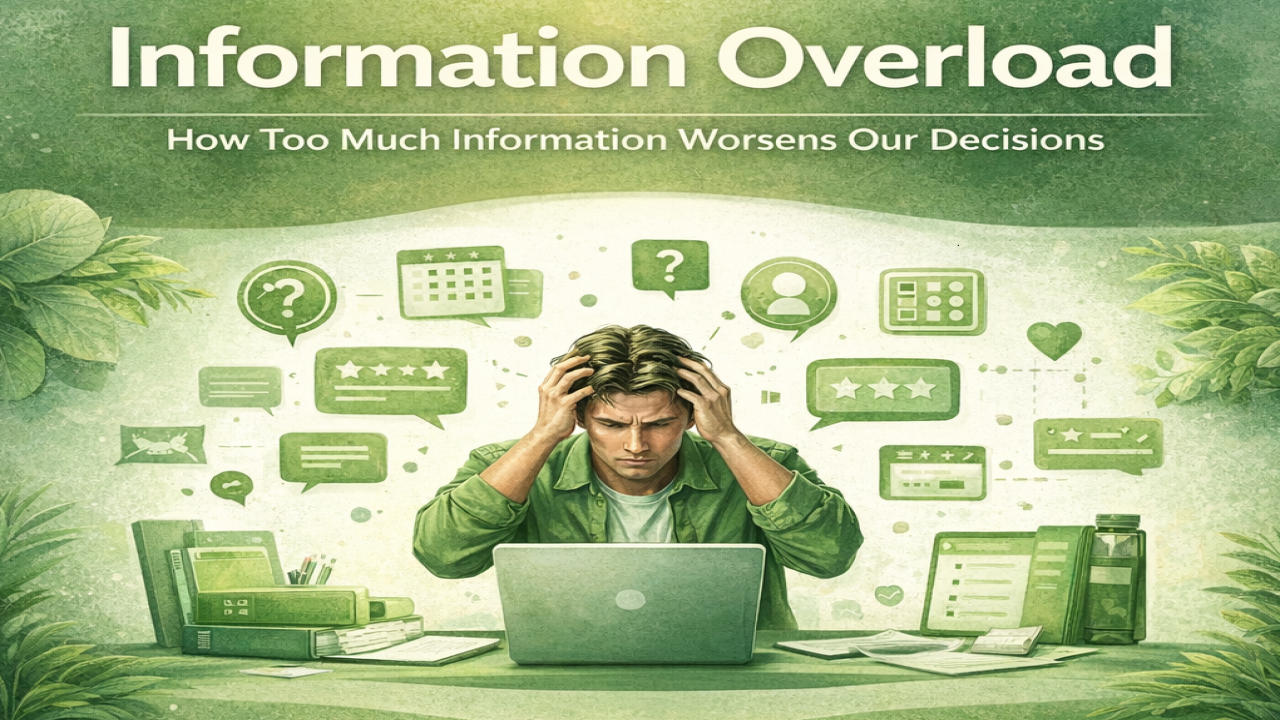
Information Overload: How Too Much Information Worsens Our Decisions
Information Overload: How Too Much Information Worsens Our Decisions
More knowledge = better decisions?
In theory, this sounds logical: the more information we have, the better our decisions.
In practice however, the opposite often happens. Especially with simple, everyday decisions.
Today’s flood of information leads to uncertainty, delays decision-making, and in hindsight we are often not particularly happy with the choice we made.
Whether it’s booking a hotel, choosing a flight, or deciding what to have for dinner. We live in a world of permanent comparability, which does not necessarily make life easier.
But why? Because of “INFORMATION OVERLOAD”.
What is information overload?
Information overload describes a state in which our brain has to process more information than it can handle efficiently. The result is not better judgment, but rather:
- Decision paralysis
- Increased uncertainty
- Mental exhaustion
- Lower satisfaction with the choice made
This phenomenon is well documented scientifically and is often referred to as choice overload or the paradox of choice.
The best example: vacation planning
I encounter this problem most often when planning vacations. Which hotel should I choose? Which flight or train should I book? Do I book everything separately or as a package?
There are hundreds of portals for all of these questions—endless opportunities to drive yourself crazy.
Before: recommendation + price → decision
Today:
- 300+ hotels
- 15 filter options
- Hundreds of reviews
- Different prices across platforms
Result:
You spend hours comparing options and still wonder afterward whether another hotel might have been better.
Another very common example is deciding what to eat for dinner. Almost everyone knows this situation. You are too tired to cook and want to go to a restaurant or order food. Then the misery begins: “What should we order?”
In a way, you are almost lucky if you live in a rural area where the selection of delivery services and restaurants is limited. But in a city? Way too much choice.
After what feels like hours of back-and-forth thinking, sometimes even accompanied by an argument, you end up ordering from the same place you always do.
This pattern now exists in almost every area of life. Buying new headphones?
Multiple platforms, dozens of filters, price comparisons, and reviews. You fight your way through all that information, only to return your first choice because you are dissatisfied and think there might be a better pair somewhere out there.
But why do we struggle with this so much?
Limited cognitive resources
Our brain works efficiently with heuristics (rules of thumb). Too many options force us into analytical comparison—and that costs energy.
Fear of making the wrong decision
The more options there are, the greater the fear of missing out on a better alternative.
Excessively high expectations
A lot of information creates high expectations. If these are not met, satisfaction decreases—even if the decision was objectively good.
Sense of responsibility
More information subjectively means more responsibility. If something goes wrong, we tend to blame ourselves.
Now that we are aware of the problem, how can we counteract it?
First, we should be clear about the impact of the decision we are about to make. A meal has less influence on our lives than, for example, booking a hotel. Once this awareness is established, the following points help with orientation:
Define decision criteria before searching for information
The most common mistake is collecting information before it is clear what the decision is actually based on. Define criteria that are measurable:
- Maximum price
- Location
- Minimum rating
Everything that meets these criteria is “good enough.” Additional information provides no decision-relevant added value.
Limit information sources
More sources increase decision time exponentially.
Recommendation:
- Use a maximum of 1–2 platforms
- No additional “control searches”
- Select three to five hotels and choose from those. Expand the selection only if all options are inadequate.
Set time limits for decisions
Decisions expand when there is no time frame. A deadline forces prioritization and reduces perfectionism.
Accept the fact that information is always incomplete
The desire for complete information is one of the biggest causes of delay.
The reality is:
- Markets are incomplete
- Information is time-dependent
- Perfect decisions do not exist
The probably most important point, however, is this: do not rethink a decision after it has been made.
You will notice that your feeling will almost always tend toward believing you did not make the best decision if you keep comparing and questioning it afterward.
More information does not automatically lead to better decisions. Especially with everyday choices, information overload blocks our ability to act and reduces our satisfaction. The art is separating theimportant stuff from excess and finding your individual balance.
Set boundaries. Think about what is important to you before you start gathering information.
Not more information leads to better decisions. Better decision-making processes lead to better decisions.
Information Overload: How Too Much Information Worsens Our Decisions
More knowledge = better decisions?
In theory, this sounds logical: the more information we have, the better our decisions.
In practice however, the opposite often happens. Especially with simple, everyday decisions.
Today’s flood of information leads to uncertainty, delays decision-making, and in hindsight we are often not particularly happy with the choice we made.
Whether it’s booking a hotel, choosing a flight, or deciding what to have for dinner. We live in a world of permanent comparability, which does not necessarily make life easier.
But why? Because of “INFORMATION OVERLOAD”.
What is information overload?
Information overload describes a state in which our brain has to process more information than it can handle efficiently. The result is not better judgment, but rather:
- Decision paralysis
- Increased uncertainty
- Mental exhaustion
- Lower satisfaction with the choice made
This phenomenon is well documented scientifically and is often referred to as choice overload or the paradox of choice.
The best example: vacation planning
I encounter this problem most often when planning vacations. Which hotel should I choose? Which flight or train should I book? Do I book everything separately or as a package?
There are hundreds of portals for all of these questions—endless opportunities to drive yourself crazy.
Before: recommendation + price → decision
Today:
- 300+ hotels
- 15 filter options
- Hundreds of reviews
- Different prices across platforms
Result:
You spend hours comparing options and still wonder afterward whether another hotel might have been better.
Another very common example is deciding what to eat for dinner. Almost everyone knows this situation. You are too tired to cook and want to go to a restaurant or order food. Then the misery begins: “What should we order?”
In a way, you are almost lucky if you live in a rural area where the selection of delivery services and restaurants is limited. But in a city? Way too much choice.
After what feels like hours of back-and-forth thinking, sometimes even accompanied by an argument, you end up ordering from the same place you always do.
This pattern now exists in almost every area of life. Buying new headphones?
Multiple platforms, dozens of filters, price comparisons, and reviews. You fight your way through all that information, only to return your first choice because you are dissatisfied and think there might be a better pair somewhere out there.
But why do we struggle with this so much?
Limited cognitive resources
Our brain works efficiently with heuristics (rules of thumb). Too many options force us into analytical comparison—and that costs energy.
Fear of making the wrong decision
The more options there are, the greater the fear of missing out on a better alternative.
Excessively high expectations
A lot of information creates high expectations. If these are not met, satisfaction decreases—even if the decision was objectively good.
Sense of responsibility
More information subjectively means more responsibility. If something goes wrong, we tend to blame ourselves.
Now that we are aware of the problem, how can we counteract it?
First, we should be clear about the impact of the decision we are about to make. A meal has less influence on our lives than, for example, booking a hotel. Once this awareness is established, the following points help with orientation:
Define decision criteria before searching for information
The most common mistake is collecting information before it is clear what the decision is actually based on. Define criteria that are measurable:
- Maximum price
- Location
- Minimum rating
Everything that meets these criteria is “good enough.” Additional information provides no decision-relevant added value.
Limit information sources
More sources increase decision time exponentially.
Recommendation:
- Use a maximum of 1–2 platforms
- No additional “control searches”
- Select three to five hotels and choose from those. Expand the selection only if all options are inadequate.
Set time limits for decisions
Decisions expand when there is no time frame. A deadline forces prioritization and reduces perfectionism.
Accept the fact that information is always incomplete
The desire for complete information is one of the biggest causes of delay.
The reality is:
- Markets are incomplete
- Information is time-dependent
- Perfect decisions do not exist
The probably most important point, however, is this: do not rethink a decision after it has been made.
You will notice that your feeling will almost always tend toward believing you did not make the best decision if you keep comparing and questioning it afterward.
More information does not automatically lead to better decisions. Especially with everyday choices, information overload blocks our ability to act and reduces our satisfaction. The art is separating theimportant stuff from excess and finding your individual balance.
Set boundaries. Think about what is important to you before you start gathering information.
Not more information leads to better decisions. Better decision-making processes lead to better decisions.


Comments (0)